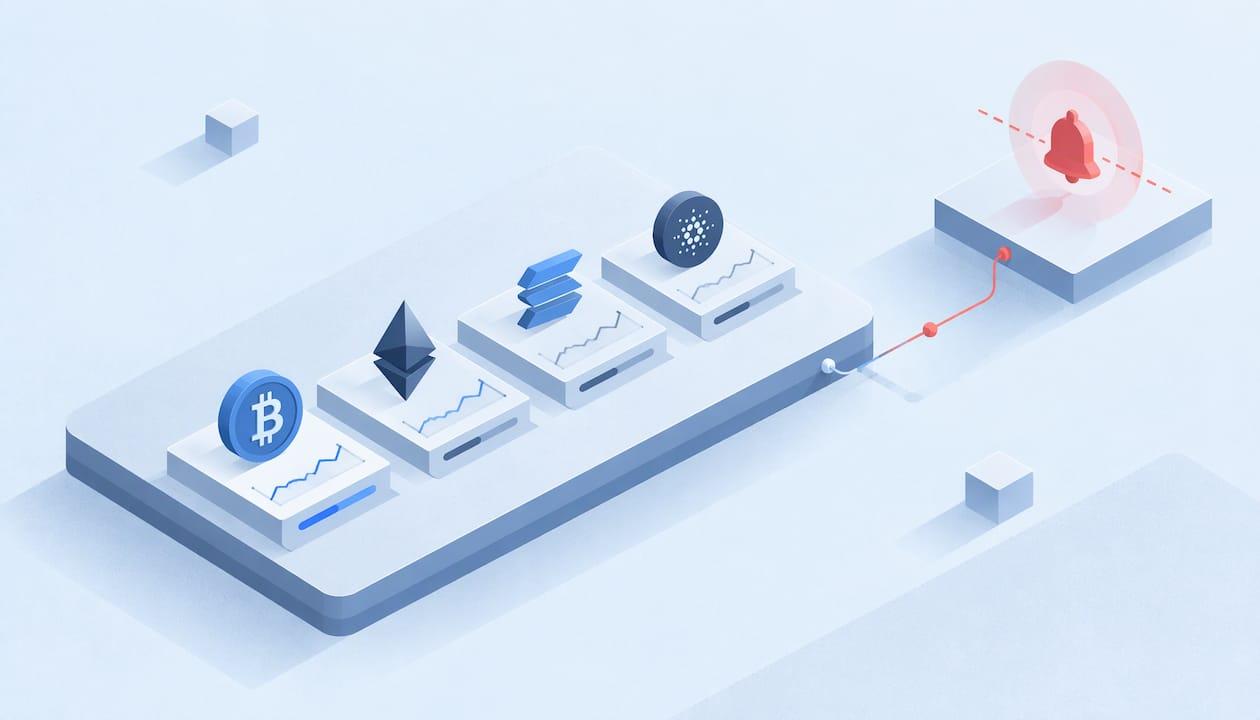
A crypto price alert is a notification that fires when a coin crosses a price you chose or moves by a percentage you chose. Set well, it saves you from watching charts all day. Set badly, it either buzzes constantly until you mute it or stays silent until the move has already happened. And no price alert tells you whether the token itself is structurally sound. If you hold more than a handful of assets, the strongest setup pairs price and percent-change alerts with risk checks on the tokens behind them, which is what we built RatioNexFlow to do.
This guide covers the alert types worth setting, how to pick a percentage threshold, why alerts miss or arrive late, and what to look at beyond price.
TL;DR
-
Use two kinds of alerts together: price-level alerts for specific numbers you care about, and percentage-change alerts for sudden moves.
-
Set percentage thresholds outside the asset’s normal daily swings, or the alert fires so often you stop reading it.
-
An alert is a notification only. It does not place orders, can arrive after the move, and can be delayed by market conditions or phone settings.
-
Price tells you what happened. Liquidity concentration, minting authority and similar structural checks tell you what could go wrong, and price alerts do not cover them.
-
RatioNexFlow’s Free plan costs €0; Pro is €29 per month or €290 per year.
Table of Contents
How crypto price alerts work
Every alert is a rule with three parts: an asset (a coin and, often, a trading pair on a specific venue), a condition, and a delivery channel. A system watches the price feed, checks your condition against each update, and sends a message when the condition is met.
The condition is where alerts differ. The two families you will use most are:
-
Price-level alerts trigger when the price goes above or below a number you pick, such as Bitcoin crossing a round number or an altcoin falling to a level you consider your exit.
-
Percentage-change alerts trigger when the price moves up or down by a set percentage over a period, such as 24 hours. You do not need to know the exact price, only how big a move is worth your attention.
The details matter. Some services require the price to cross the level in the relevant direction, so a move away from the level does not trigger an alert, as one exchange’s help guide explains. Some alerts fire once and switch off; others repeat every time the condition recurs. A level alert that fires once is fine for a target you only care about reaching one time. A repeating alert on a volatile coin can bury you.
The alert types worth setting
Most US exchange apps offer a subset of the same toolkit. A major US trading app’s support article lists three kinds for coins you hold, watch or previously held: key price levels, price movements at 5% or 10%, and highs and lows over windows from one month to all time. It also lets you set a custom price alert from a coin’s detail page.
For a portfolio, a practical set looks like this:
-
Downside level on each large position. Pick the price at which you would want to reassess, not necessarily sell. This is the alert that matters most.
-
Upside level on each position with a target. If you have a plan to trim at a number, make the alert match the plan.
-
Percentage-change alert on your biggest holdings. This catches sudden moves you did not anticipate, in either direction.
-
Highs and lows alerts on long windows. A new multi-month low or high is often a more useful signal than an arbitrary round number.
Keep the total manageable. Many apps and exchanges limit how many alerts you can have at once or how often they can fire, so review frequency and threshold settings before you rely on them. The same trading app’s price-alerts disclosure page tells users to do exactly that, and states that notifications are informational only and not a recommendation to buy, sell or hold.
Choosing a percentage threshold
This is where most alert setups fail. The percentage you choose must be larger than the asset’s normal daily range, or the alert becomes background noise.
The formula
A percentage-change alert measures the move from a reference price:
(current price − reference price) ÷ reference price × 100
The reference depends on the product. It might be the price 24 hours ago, the previous candle’s close, or the price at the moment you saved the alert. Check which one your tool uses, because a “5% alert” means different things under each.
A worked example
Suppose a coin trades at $100 at the reference point. A 5% alert fires at $105 or $95. A 10% alert fires at $110 or $90. If the coin routinely swings 4% in a quiet day, a 5% alert will trigger on ordinary days and a 10% alert will trigger only on days that deserve a look. This is an illustration, not a forecast: the right number comes from the asset itself.
How to calibrate
-
Open the chart for the asset and look back several weeks.
-
Count how many days it moved by your candidate percentage.
-
If that is most days, raise the threshold. If it would have fired only once or twice, you have a signal worth keeping.
-
Repeat for each asset. Large, established coins move less in a day than small-cap tokens, so one threshold for everything is almost always wrong.
Remember also that short-timeframe alerts are inherently noisy. A thin spike can touch a level and reverse. Alerts based on a candle that is still open can change before the candle closes, so a detected crossing is not always a confirmed one.
Weekly, daily or hourly?
Match the window to how you act. If you check your portfolio once a day, a 24-hour percentage alert fits. If you trade actively and can respond within minutes, a shorter window helps, but accept that you will receive more alerts and tune accordingly. A portfolio manager watching dozens of positions generally wants wider thresholds and fewer alerts, because the goal is exceptions, not a running commentary.

Custom alert rules and how often they fire
Beyond a simple level, charting platforms let you set a trigger frequency (once, every time, once per bar close, once per minute), an expiration or an open-ended setting, and a custom message. Not every tool offers all of this, but the habits carry over:
-
Use “once” for targets. You want to know when a price is reached, not be reminded every minute afterward.
-
Use a cooldown or daily cap for volatility alerts. One US payments app, for instance, caps crypto price alerts at two notifications in a 24-hour period, according to its help center. A cap protects your attention but also means you may not hear about every move.
-
Put expiry dates on tactical alerts. An alert for a trade idea from last month is clutter today.
-
Write a message that tells you what to do. “Level 2: reassess stop and position size” beats “BTC alert.”
Why alerts arrive late, or not at all
Alerts are a chain: price feed, rule check, delivery service, your phone. Any link can fail.
-
Market conditions and data outages. The same payments app’s help page says alerts may be delayed or disrupted by market conditions and data outages, and that you should verify the information before acting.
-
Delivery is not guaranteed. The trading app’s support page says it cannot always guarantee push delivery, because it depends on service availability and on your app and phone settings.
-
Your settings. Missed alerts commonly trace back to operating-system notification permissions turned off, browser permissions denied, an email-only channel you do not check, or the wrong trading pair or quote currency.
-
Speed. A percentage alert can only fire after the move has happened. By the time you read it, the market may have moved further.
A simple routine fixes most of this. Confirm notification permissions on your phone after every operating-system update. Send a test alert at a price very close to the market to confirm it reaches you. For positions that matter most, use more than one channel, for example push plus email. And treat every alert as a prompt to look at the position, not a trade instruction.
What price alerts cannot tell you
A price alert answers one question: did the number change? It cannot tell you why, or whether the asset is built in a way that makes a collapse more likely. A touch of a level means little without context such as volume and trend, and an alert does not manage risk for you. Decide your entry, exit and position size before the notification arrives, not after.
That gap matters for anyone assessing risk in a portfolio. Some of the worst losses in crypto do not begin with a gradual price slide. They begin with a structural weakness that was visible in advance:
-
Liquidity concentration. If most of a token’s liquidity sits in one pool or with a few holders, a single exit can push the price down hard, and you may not be able to sell at the quoted price.
-
Minting authority. If someone can still create new tokens, supply can be diluted at will, and the price you see today does not reflect that exposure.
By the time a price alert fires on a drop like that, the damage is done. These are structural checks, and they are different from price monitoring. They are the checks we designed RatioNexFlow around, and traditional portfolio trackers tend to overlook them.
A practical alert plan for your portfolio
Here is a routine you can set up in an afternoon.
-
List your holdings by size. Alerts on the top positions matter most. A 50% move in a token that is 1% of your portfolio is less urgent than a 10% move in one that is 40%.
-
Set a downside level on each large position. Base it on your plan, a recent support area, or the amount of loss you can accept.
-
Add a percentage-change alert, calibrated. Use the calibration steps above, asset by asset.
-
Choose your channels. Push for speed, email as a backup.
-
Review risk beyond price. For every token you hold, ask who can mint more, where the liquidity sits, and whether anything about the token’s structure has changed.
-
Review monthly. Delete stale alerts, widen noisy ones, and add alerts for new positions.
If you hold coins across several exchanges and wallets, the practical problem is that price alerts live in different apps with different rules. Bringing positions into one place makes steps 1 to 5 much easier. Our exchange portfolio guides show how that works for specific exchanges.
Where RatioNexFlow fits
RatioNexFlow is a crypto portfolio intelligence platform. It connects to popular exchanges, accepts transaction statements and manual or file-based imports, and gives you price and percent-change alerts alongside portfolio tracking, ROI and analytics, charts and headline aggregation. For each token it applies rule-based risk flags, including structural checks such as liquidity concentration and minting authority, so the questions price alerts cannot answer sit next to the numbers you already watch.

Access is read-only. We never take custody of your assets and never require trading or withdrawal rights, which you can read about on our security page.
The Free plan costs €0. Pro adds enhanced analytics, exchange syncing, wallet tracking, unlimited alerts and advanced market intelligence, at €29 per month or €290 per year. See the pricing page for what each plan includes.
If you want alerts and risk checks in one place, start with RatioNexFlow. Our risk disclosures explain what the platform’s flags are and are not.
Our view: alerts are the smoke detector, structure is the wiring
A price alert is a smoke detector. It tells you something is already burning. That is valuable, and everyone holding crypto should have them set on their biggest positions. But the better question is why the fire started, and whether you could have seen it earlier.
When we look at a portfolio, we want to know three things before we look at the chart. Who can create more of this token? How much of the liquidity sits in one place? Does the token behave the way its rules say it should? None of those show up in a price feed until it is too late to act calmly.
That is why we built a rule-based threat protection engine on top of tracking and alerts, rather than another alert tool. Each token is checked against structural rules and flagged. You stay in control, because access is read-only and we never hold your funds. The flag is a prompt for your own decision, and the decision stays yours.
Our advice is simple. Set fewer, better alerts. Calibrate them to each asset. And pair them with risk checks so you are reacting to evidence, not just to a falling number.
Henry
FAQ
Are crypto price alerts free?
Many exchange apps include basic price alerts at no charge. Our Free plan costs €0, and Pro, which adds unlimited alerts, exchange syncing, wallet tracking and advanced market intelligence, is €29 per month or €290 per year. Check the pricing page for the plan details.
What percentage should I use for a crypto volatility alert?
Use a figure larger than the asset’s normal daily swing. Look back several weeks, count how many days it moved by your candidate percentage, and raise the number if it would have fired most days. Large, established coins typically need smaller thresholds than small-cap tokens, so set each asset separately.
Why did my crypto alert come late or not at all?
The usual causes are notification permissions turned off on your phone or browser, the wrong trading pair, an email-only setting, or delays from market conditions and data outages. A percentage alert also fires only after the move. Send a test alert, enable a second channel for key positions, and verify the price in your app before acting.
Can an alert buy or sell for me?
No. A price or percentage alert is a notification only. It does not place an order, and it is not a recommendation to buy, sell or hold. Decide your entry, exit and position size in advance, and use the alert as a prompt to review.
Do price alerts warn me about risky tokens?
Only after the price moves. Structural risks such as concentrated liquidity or remaining minting authority do not appear in a price feed. Our risk flags check tokens against those structural rules so you can see them before a price drop.